
I chew ice all the time. Always have and I suspect I always will. It’s my thing. However, when someone approached me at work once to suggest I check my iron levels, I was shocked. True, I struggled with anemia in my childhood, but I had never made the link between my love of chewing ice to my known tendency to be iron deficient.
Let’s be clear, chewing ice does not make you anemic, but it may be a sign that you have an iron deficiency anemia. People with this condition have been known to crave and chew ice (pagophagia) for unknown reasons, possibly to increase blood flow and oxygen to the brain.
Iron-deficiency anemia occurs when your body does not have enough iron to form healthy red blood cells, and most commonly the result of inadequate dietary intake and/ or blood loss (this includes from heavily menstruation). One way to solve this is to simply take iron supplements, but I personally always attempt to fuel my vessel/ body to help it heal itself – and that means finding creative ways to increase my consumption of iron naturally (through my diet).
So, the recommended daily allowance of iron depends on a person’s age and sex. A adult female aged 18-50 years needs 18 mg/ day. This increases to 27 mg/ day for pregnant women. Women with iron-deficiency anemia need a significant boost and may require 150-200 mg/ day (or 2-5 mg/ kg of their body weight). This looks like a crazy ‘boost’ to me, and to be completely honest, I’m wondering if that amounts to a baby cow each week cause that’s a significant increase!
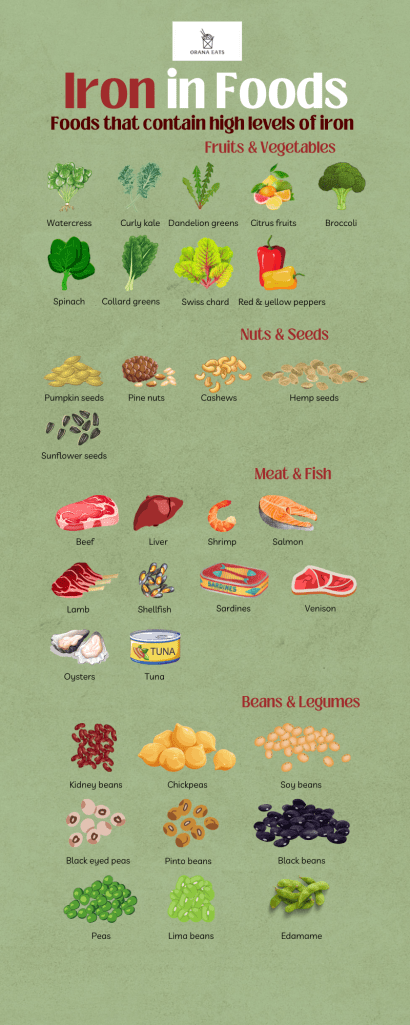
Going down the rabbit hole, I did discover foods to avoid if you’re trying to increase your iron uptake (as they may interfere with iron absorption):
Calcium – Although calcium is an essential nutrient, consuming more than 300-600 mg can interfere with iron absorption. This includes dairy products, certain fish, tofu, etc.
Phosvitin – This is an iron-inhibiting phosphoprotein contained in eggs. One egg contains about 6 mg of iron and can reduce a person’s iron absorption by as much as 28%.
Oxalates – These are compounds derived from oxalic acid and can inhibit non-heme iron absorption. Non-heme iron comes from plant foods like rhubarb, strawberries, chocolate and some herbs.
Polyphenois & Tannins – These also inhibit iron and are found in certain herbs and teas, chocolate and coffee. Swedish cocoa and certain teas can reduce iron absorption by as much as 90% and coffee can reduce it by as much as 60%. (This is a hard pill to swallow… I love coffee and tea and drink multiple cups each day).
So, for the next few months (at least until the end of the year), I’m going to be switching things up nutrition-wise. I’m excited. I’ve never cooked with Bok Choy, but why the hell not? This is going to be fun, and as usual, I’ll keep you guys updated as much as I can (actually, whenever I remember to since I’m out here living this thing called ‘Life’).
Have an amazing day!
 Orana Eats: Food | Wellbeing | Travel